Devpost
Participate in our public hackathons
Devpost for Teams
Access your company's private hackathons
Grow your developer ecosystem and promote your platform
Drive innovation, collaboration, and retention within your organization
By use case
Blog
Insights into hackathon planning and participation
Customer stories
Inspiration from peers and other industry leaders
Planning guides
Best practices for planning online and in-person hackathons
Webinars & events
Upcoming events and on-demand recordings
Help desk
Common questions and support documentation
After reviewing the approved data, we....
Studying spatiotemporal migratory patterns of Monarch Butterflies gives insight into where and when support for these pollinators is most crucial.
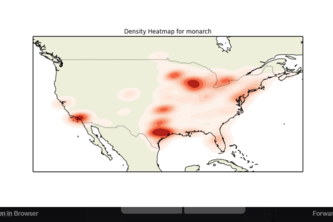
We created a custom GPT model to generate CSV's from 2010 to 2024 populated with counties, FIPS, AQI, and Tempurate data. We generated heat maps for Monarch Counts, and analyzed via an NBR Model.
This project explores ways to support the population recovery of the Monarch Butterfly through data analysis and collaboration with external organizations to improve their survival chances.
saving pollinators through actionable change in pesticide usage
Populations are decreasing in the United States. Our mission was to analyze the data. Through analysis, we have found the problems. Pesticides are a large problem, specifically the Neonicotinoids.
A Tragic Data Story
csv-ing the butterflies one file at a time
Select and analyze relevant data, interpret your findings, and recommend a strategy for declining populations of monarch butterflies
We analyzed pesticide data across key US states in the monarch butterfly migration path, focusing on harmful chemicals to assess the risks they pose to monarch habitats.
Our project, Is didecated to Homero Gómez González who dedicated his life in the protection and analisys of monarch butterflies. we leveraged advanced data analysis and machine learning
We have solved the problem of the declining population of Monarch butterflies.
Investigating the Decline of Monarch Butterflies
Empowering Conservation with Data to Protect Monarch Butterflies
.
Our analysis reveals pesticides are driving monarch butterfly decline. Reducing pesticide use and restoring key habitats to reverse this trend may aid in both biodiversity and agricultural ecosystems.
This project utilizes multiple software programs to interpret multiple correlating factors between monarch butterfly egg sightings and pesticide concentration per state.
We analyzed data involved with the decline of the monarch population and investigating its correlation with various pesticide usages.
In this study, we observe the growth trends associated with Montana's monarch butterfly population, and we analyze how the concentration of pesticides could potentially influence these growth trends.
Our project identifies key areas where reducing pesticide use can most effectively support Monarch migration & reproduction, highlighting the correlation between pesticide exposure & milkweed decline.
Our team discovered basic insights on the decline of the monarch butterfly population by cleaning, preparing, analyzing, and visualizing pesticides and sightings.
Inform people about the correlation surrounding the decreased sightings of Monarch Butterflies and air quality.
The data we reviewed led to the conclusion that in the last 10 years there has been a negative impact to monarch butterfly migration due to global warming affecting overall air quality.
Food security is vital. Factors like temperature, rain, soil, and pollinators impact food production. Pesticides harm pollinators. We track pesticides and Butterfly migration to find patterns.
1 – 24 of 30